
Sky Path
2018
Light / Refraction / Wind
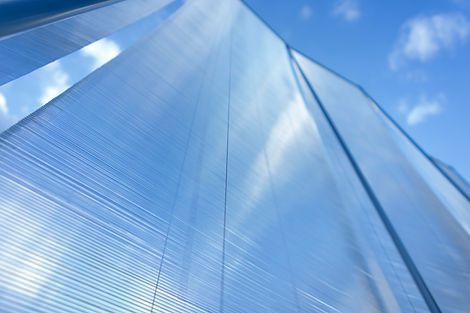
A line of moonlight stretching across the sea becomes the starting point for Sky Path. The work investigates how natural light can be guided through space by structure. Transparent triangular acrylic rods capture incoming sunlight and repeatedly reflect and refract it, producing luminous lines that travel through the installation. As the sun’s altitude changes, the position and intensity of these lines shift throughout the day. In winter, low western sunlight generates long continuous reflections that traverse the space like a single luminous trajectory. The structural system adapts the mechanical principle of bamboo blinds, allowing loads to be distributed across the frame rather than concentrated at a single point. Each panel stands independently while remaining visually connected to the others like a folding screen.
Subtle movements in the structure slightly displace the light lines, while the viewer’s position alters their perceived geometry. Sky Path creates a spatial framework through which natural light can move and reveal its changing path.
Year
2018
Location
Tokyo, Japan
Material
Triangular acrylic rods, Erector Pipe
Size
H 4000 × W 8150 × D 4800 mm
Element: H 4000 × W 1000 × D 28 mm
Exhibition
Graduation Exhibition
Venue
Tokyo University of the Arts


PHENOMENA
Sunlight trajectory
Seasonal solar altitude
Atmospheric brightness
↓
APPARATUS
Triangular acrylic rods
Reflective geometry
Distributed frame
↓
SPATIAL EXPERIENCE
Moving lines of light
Evolving spatial paths
Perception through movement
The project began with the image of a bright trail of moonlight stretching across the sea. This phenomenon suggested that light could be understood not only as illumination but as a path moving through space. Sky Path translates that observation into a spatial structure. Transparent acrylic rods receive incoming sunlight and redirect it through reflection and refraction. As the sun moves, the luminous lines shift accordingly, forming temporary trajectories that connect the elements of the installation. The structural frame borrows the distributed mechanics of bamboo blinds, enabling flexibility and subtle movement. The installation does not reproduce the sea’s reflection but creates the conditions through which light can draw its own path. Time, motion, and perception intersect within the structure, allowing the trajectory of natural light to become visible.


Year
2018
Location
Tokyo, Japan
Type
Research Installation
Material
Triangular acrylic rods, Erector Pipe
Dimensions
H 4000 × W 8150 × D 4800 mm
Element
H 4000 × W 1000 × D 28 mm
Exhibition
Graduation Exhibition
Tokyo University of the Arts
Tokyo University of the Arts
Award of Design N 2018
Cooperation
Yoichi Suzuki (Sumida Manufacturing Co., Ltd.)
Shooting
Takatoku Nishi
Video Editing
Takatoku Nishi
